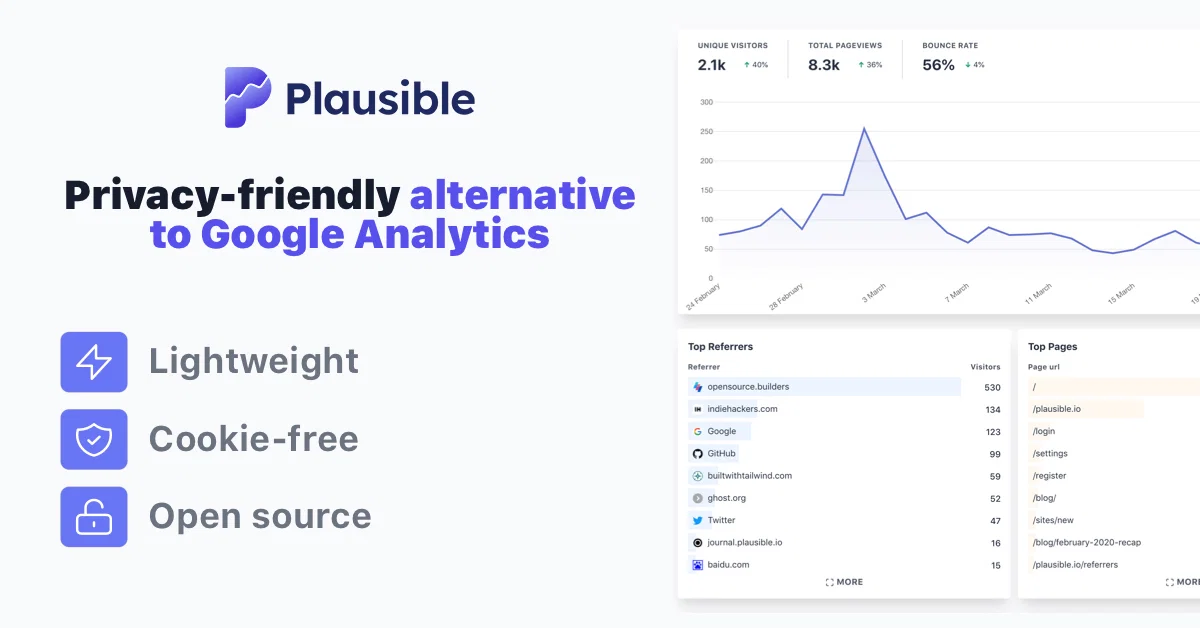
Focused, Cookie-Free Web Analytics for Teams That Don’t Want GA4
Google Analytics has become too much product for a lot of websites.
For enterprise marketing teams, that complexity can be useful. For smaller companies, SaaS teams, agencies, public-sector sites, indie products, and content businesses, it often creates the opposite problem: too many reports, too much configuration, unclear privacy trade-offs, and a dashboard that feels like it was built for ad infrastructure first and site owners second.
That is where Plausible Analytics makes sense. It is not trying to become a full marketing cloud, customer data platform, heatmap suite, session replay tool, or advertising attribution engine. It is deliberately narrower than that.
Plausible is web analytics for teams that want to understand traffic, sources, content performance, goals, funnels, campaigns, and conversions without cookies, personal data collection, or cross-site tracking. That focus is the point.
For a project like Webfolio, which still uses Google Analytics today, Plausible is exactly the kind of alternative that becomes interesting over time: EU-hosted, privacy-first, simple to understand, and better aligned with a product philosophy that does not want analytics to feel invasive.
What Plausible is
Plausible is a privacy-focused web analytics platform built as a Google Analytics alternative. It is made and hosted in the EU, runs on European-owned infrastructure, and operates under EU data protection law.
The product tracks website performance in aggregate without cookies and without collecting personal data. It does not do cross-site or cross-device tracking, and visitor behavior is not monetized. The company’s business model is subscription-based, so customers fund the product rather than advertising, data resale, or surveillance-style tracking.
That matters because analytics tools are not neutral infrastructure. The way they collect data shapes your compliance posture, your site UX, your cookie banner strategy, and the level of trust you can reasonably offer visitors.
Plausible also has a useful company story behind it. It was started in 2018 by Uku Taht as a simple, privacy-friendly analytics alternative. Paid subscriptions launched in 2019, Marko Saric joined in 2020 to lead marketing and communications, and the company crossed $1 million in annual recurring revenue in 2022. Today, it has more than 17,000 paying subscribers.
The product is open source under AGPLv3, which gives technical teams an extra level of accountability. You can inspect the code, review how the platform works, and avoid the feeling that your analytics vendor is a black box.
Who Plausible is for
Plausible is a good fit for teams that want reliable website measurement without turning analytics into a heavy implementation project.
It works especially well for:
Startups and small SaaS teams
If your main questions are "where is traffic coming from?", "which pages convert?", "which campaigns work?", and "where do users drop off?", Plausible covers the core workflow cleanly.
The dashboard is designed to be understandable without analytics training, which makes it easier to share with founders, marketers, developers, and non-technical stakeholders.
Content sites and SEO-driven businesses
Plausible has a strong content and SEO angle. You can connect Search Console, monitor search queries and organic performance, track scroll depth automatically, and see which pages attract visitors from AI tools like ChatGPT, Perplexity, or Claude.
That last point is increasingly useful. Search is no longer only "Google query → blue link → website." AI assistants and answer engines are becoming part of the discovery path, and Plausible gives teams a way to see that traffic in the same analytics workflow.
Privacy-sensitive organizations
Plausible is well matched to organizations that care about data minimization. Public sector teams, regulated companies, EU-hosted products, and privacy-conscious businesses can use it without relying on cookies or collecting personal data.
The product’s positioning is not just "analytics with a nicer UI." It is analytics with a different data model.
Agencies and client-facing teams
Shared links, embedded dashboards, email reports, Slack reports, team management, and multi-site plans make Plausible practical for agencies and consultants. It is also easier to explain to clients than GA4, which is not a small advantage.
Engineering-led teams
Developers will appreciate the open-source model, lightweight script, Stats API on the Business plan, and the fact that the product does not sprawl into unrelated categories.
That narrowness is a strength. Plausible feels like an analytics product, not a platform trying to absorb every adjacent workflow.
Capabilities and how Plausible fits into a stack
Plausible’s strongest quality is that it keeps the analytics loop short. Add the script, open the dashboard, and you get a clear picture of what is happening on your site.
A focused analytics dashboard
The core dashboard is built around practical website questions:
- How many people visited?
- Which pages are getting traffic?
- Where are visitors coming from?
- Which campaigns are working?
- Which goals are converting?
- Which countries or locations are driving activity?
- What is happening right now?
The real-time dashboard updates every 30 seconds without refreshing the page. That is useful during launches, newsletter sends, product announcements, paid campaigns, and incident checks.
Lightweight tracking
Plausible’s script is significantly smaller than Google Analytics. The company positions it as 54 times smaller, with every visitor downloading 135KB less JavaScript.
That is not just a performance talking point. Lighter scripts reduce page weight, improve UX, and lower the amount of unnecessary data transfer. Plausible also frames this as an environmental benefit, estimating that a site with 100,000 monthly visitors can save around 4kg of CO2 per year by switching.
Privacy-first measurement
Plausible does not use cookies, does not collect personal data, and does not use persistent identifiers. Analytics data is processed in aggregate.
For many teams, this is the feature that matters most. It reduces regulatory complexity, avoids visitor-level tracking, and supports a cleaner user experience without analytics cookie banners.
Goals and conversions
Plausible includes codeless goals and custom events. You can turn page visits into goals, track file downloads, form completions, and external link clicks, and set up revenue tracking.
That gives the product enough conversion depth for most marketing sites, SaaS landing pages, content businesses, and ecommerce-adjacent workflows.
On the Business plan, Plausible also includes funnels, which let you measure how visitors progress through a sequence of steps and where they drop off.
SEO and AI traffic visibility
The Search Console integration brings search queries and organic performance into the Plausible dashboard. That is useful because SEO work often gets split between analytics dashboards, Search Console, spreadsheets, and reporting tools.
Plausible also tracks traffic from AI tools such as ChatGPT, Perplexity, and Claude. For teams investing in content, documentation, product-led SEO, or educational resources, that gives a clearer view of how discovery is changing.
Campaign tracking
Plausible supports UTM campaign tracking with automatic channel grouping, including channels like Paid Search and Affiliates.
That makes it suitable for lean marketing teams running newsletters, sponsorships, paid search, affiliate campaigns, product launches, and social campaigns without needing a heavyweight attribution suite.
Bot filtering
Built-in bot filtering helps exclude bots, referrer spam, and data center traffic. This matters because smaller sites can have their numbers distorted quickly by junk traffic.
Clean analytics are not only about collecting less data. They are also about filtering the noise well enough that the dashboard remains useful.
Reporting and team workflows
Plausible includes email and Slack reports, saved segments, shared links, embedded dashboards, shared segments on higher tiers, team management, and a consolidated view on the Business plan.
That makes the product easier to fit into a real company workflow. The analytics dashboard is not just for one technical person; it can be shared with clients, founders, marketing teams, leadership, or public-facing audiences.
Realistic scenarios
A startup replacing GA4 on its marketing site
A small SaaS team wants to understand traffic, trial signups, demo requests, and campaign performance. GA4 technically handles all of that, but the team finds it too heavy for day-to-day use.
With Plausible, they can track goals, monitor campaigns, connect Search Console, and send Slack reports without building a custom reporting process. The main benefit is not that Plausible has more features than GA4. It is that the useful features are easier to reach.
A content team watching SEO and AI discovery
A publisher or niche content site wants to know which articles get search traffic, which pages keep readers engaged, and whether AI tools are starting to send visitors.
Automatic scroll depth tracking, Search Console data, AI referrers, and simple content-level analytics make Plausible a strong fit here. The team gets enough information to make editorial decisions without drowning in audience surveillance.
A privacy-conscious EU product
A European software company wants its analytics stack to match its privacy messaging. It still needs useful business data, but it does not want cookies, personal data collection, or cross-site tracking.
This is where Plausible’s positioning is strongest. The product gives the team practical measurement while staying aligned with a privacy-first product philosophy.
That is also why it is relevant for something like Webfolio. Webfolio still uses Google Analytics, but Plausible feels like a credible future migration candidate because the product matches the idea of running a cleaner, more privacy-conscious stack.
An agency reporting to clients
An agency manages several client websites and needs analytics that clients can actually understand.
Plausible’s shared links, embedded dashboards, email reports, Slack reports, and multi-site plans make it easier to give clients visibility without onboarding them into GA4’s complexity. For many client relationships, that simplicity is a feature.
The obvious question
The skeptical question is simple: is Plausible mostly convenience?
Could you use Google Analytics for free? Yes.
Could you self-host an analytics tool? Possibly.
Could you parse server logs with something simpler? For some use cases, yes.
So the case for Plausible is not that web analytics cannot be solved any other way. The case is that Plausible packages the right analytics workflow into a focused, privacy-respecting product with less operational drag.
That distinction matters.
If you are running a tiny personal site with a few hundred visits a month and you only check traffic once a quarter, Plausible may be more product than you need. Even at a fair €9/month starter price, free tools will always exist.
But once analytics becomes part of a team workflow, the value changes. You are paying for a clean dashboard, consistent tracking, bot filtering, goals, reports, team access, EU-hosted infrastructure, open-source accountability, and a product that does not push you toward advertising-driven tracking.
Plausible is also refreshingly narrow. It does not try to become a CRM, heatmap tool, ad platform, session replay engine, email suite, or customer journey warehouse. That makes it less suitable for teams that need deep behavioral analytics or ad ecosystem integrations, but better for teams that want web analytics to stay web analytics.
Before adopting it, I would still ask a few practical buyer questions:
- How do data export workflows work across CSV, API access, and raw event exports?
- Are there sampling limits or behavioral differences at very high traffic volumes?
- What custom event and custom property limits apply by plan?
- How does Google Analytics import behave for older historical data?
- Is the Stats API rate limit enough for your reporting or BI workflow?
- What support expectations apply outside the Enterprise plan?
- How should teams choose between Growth, Business, and Enterprise when managing many sites?
- If using open-source deployment options, which managed-cloud features are or are not included?
None of these are deal-breakers. They are the normal diligence questions you ask before putting any analytics tool into a production stack.
Pricing overview
Plausible uses traffic-based pricing. The listed base pricing starts at up to 10,000 monthly pageviews, with a 30-day free trial and no credit card required.
| Plan | Base price | Best for | Key limits and features |
|---|---|---|---|
| Starter | €9/month | One small site | 1 site, 3 years retention, dashboard, email/Slack reports, Google Analytics import, goals, custom events, saved segments |
| Growth | €14/month | Small teams | Everything in Starter, up to 3 sites, up to 3 team members, team management, shared links, embedded dashboards, shared segments |
| Business | €19/month | Growing teams and reporting workflows | Everything in Growth, up to 10 sites, up to 10 team members, 5 years retention, custom properties, Stats API, Looker Studio connector, ecommerce revenue attribution, funnels, consolidated view |
| Enterprise | Custom | Larger organizations | 10+ sites, 10+ team members, higher API needs, Sites API, SSO, managed proxy, scheduled raw event exports, 5+ years retention, priority support |
The €9 Starter plan feels fair for what Plausible offers, especially if the alternative is spending time wrestling with a more complex analytics setup or compromising on your privacy posture.
Annual billing includes two months free. Pricing and plan limits can change, so it is worth checking the current plan details before committing.
Plausible or not Plausible?
Plausible is not trying to win by having the longest feature list. It wins by being focused.
That is probably the best thing about it.
It gives site owners the analytics they usually need, traffic, sources, goals, campaigns, SEO visibility, funnels, reporting, and real-time monitoring, without pulling them into the heavier world of advertising analytics, cookie consent complexity, and visitor-level tracking.
For teams that need deep ad attribution, remarketing audiences, session replay, or a broader marketing automation platform, Plausible will feel intentionally limited. For teams that want fast, readable, privacy-friendly analytics hosted in the EU, that limitation is exactly why it works.
The practical next step is simple: open the live demo, compare it against the reports you actually use today, and start a free trial on a real site. If your analytics needs are focused, Plausible is one of the more convincing Google Analytics alternatives available.