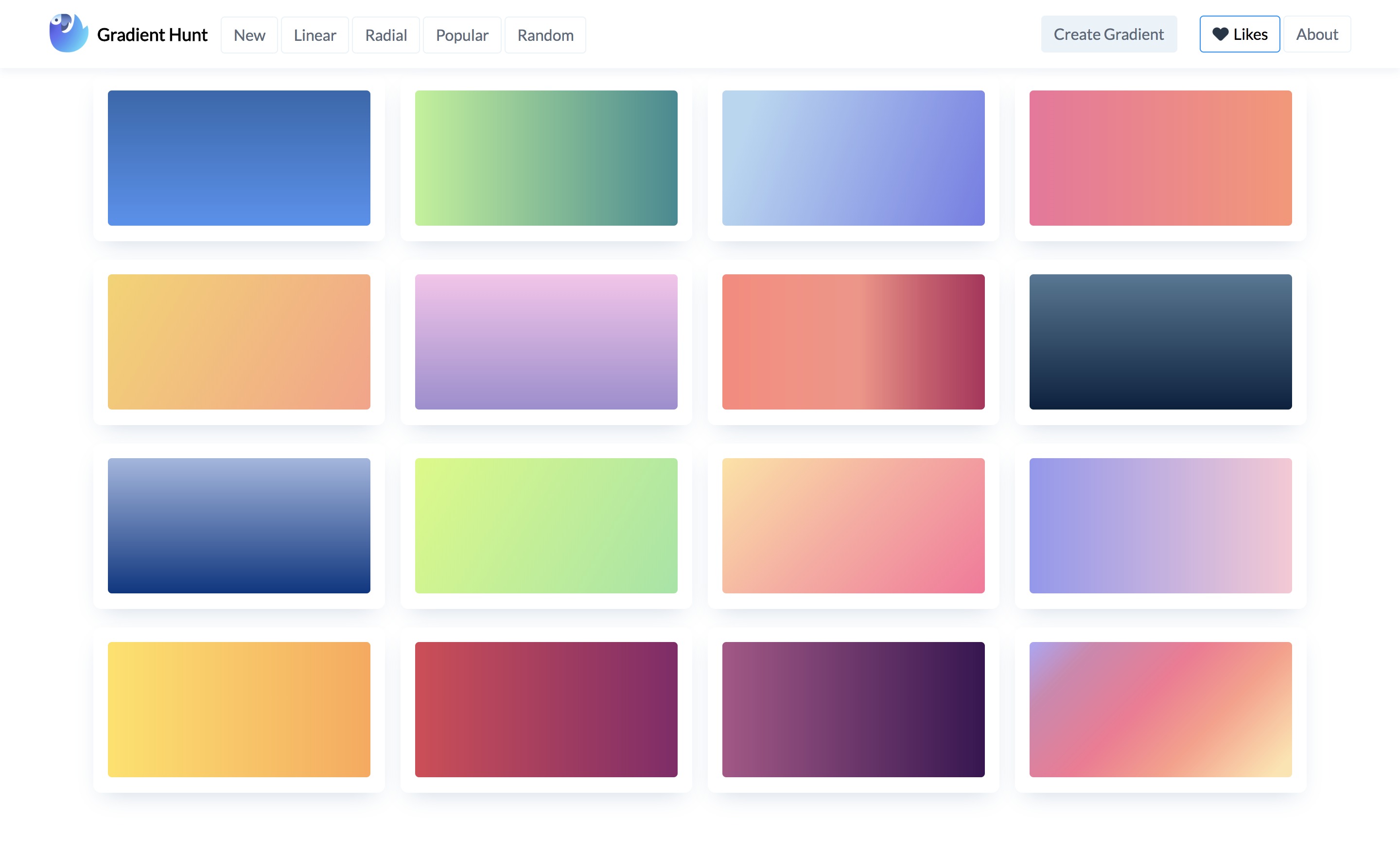
When you need color inspiration faster than your brain can make a decision
Sometimes the hardest part of a design is not layout or structure. It is getting past that moment where everything looks flat and nothing quite clicks visually. You know a gradient could help, but opening a color picker and building one from scratch feels like unnecessary friction.
That is where Gradient Hunt fits in.
It is not a design tool in the traditional sense. It is closer to a shortcut. A place you go when you want something that already works, so you can move forward without overthinking it.
What Gradient Hunt is, in plain terms
Gradient Hunt is a free, open collection of color gradients launched in 2018 by Franco Maldonado. The idea is simple: gather a large number of visually appealing gradients in one place and make them easy to access.
The collection is built by users. People submit gradients, and the strongest ones get featured on the homepage. Over time, this creates a library that reflects a wide range of styles rather than a single design perspective.
Everything in the collection is free to use. That alone makes it stand out in a space where even small design assets are often gated behind subscriptions.
The goal, as described by the project itself, is to make the internet a nicer and better-looking place by giving people quick access to good color combinations.
What it seems built for
Gradient Hunt is clearly aimed at people who work visually but do not want to spend all their time refining color details.
The site itself calls out a wide mix of users: web designers, illustrators, photographers, product designers, fashion designers, interior designers, brand designers, and developers.
Put simply, it is for anyone who needs gradients as part of their work, but does not want to reinvent them every time.
It makes particular sense for:
- Designers looking for quick inspiration
- Developers who want ready-to-use visual ideas for interfaces
- Creators working on mockups, content, or branding
- Solo builders who need things to look good without slowing down
The emphasis is not on control or customization. It is on speed and access.
What you can actually do with Gradient Hunt
Gradient Hunt keeps things simple, and that simplicity is part of the appeal.
Browse a large, growing collection
At its core, the product is a library. Thousands of gradients, continuously expanded through user submissions.
Use gradients in your own work
The gradients are free to use, which removes friction immediately. You are not browsing just for inspiration. You are browsing for something you can actually apply.
Explore community-created work
Because gradients are submitted by users, the collection reflects a mix of styles and ideas. The homepage highlights the best of these, which acts as a form of lightweight curation.
Build your own collection
The platform mentions the ability to keep a personal collection of gradients you like. While the exact mechanics are not deeply explained, the intent is clear: you can come back to what works for you.
Get passive inspiration with Gradient Tabs
There is also a Chrome extension called Gradient Tabs. Instead of actively browsing, it surfaces a gradient every time you open a new tab, pulled from popular entries in the collection.
It is a small feature, but it reinforces the idea that inspiration does not always have to be intentional.
A few realistic scenarios
You are finishing a UI and something feels flat
Instead of tweaking colors manually, you browse a few gradients, find one that fits the tone, and move on. The goal is not perfection. It is momentum.
You are building a quick project and want it to look polished
For side projects or internal tools, Gradient Hunt gives you a fast way to add visual depth without investing time in color theory.
You are exploring visual direction early on
When you are still figuring out a look and feel, seeing a range of gradients can help narrow down what direction makes sense.
You want lightweight, ongoing inspiration
With Gradient Tabs, gradients show up in the background of your day. It is not structured research, but it keeps your eye tuned to color combinations.
The obvious question
At some point, the practical question comes up:
Why not just make your own gradients?
You can. Most design tools and even basic CSS make gradient creation easy. For a single project, building one manually is not a big lift.
So the value here is not about capability. It is about efficiency and perspective.
Gradient Hunt removes the need to start from zero. Instead of experimenting blindly, you begin with something that already looks intentional. That can save time, especially when gradients are not the main focus of the work.
It also introduces combinations you might not have thought of. That is one of the quieter advantages of a community-driven library. You are not limited to your own habits.
That said, the product stays deliberately lightweight. It is not positioned as a system for managing design assets or integrating into complex workflows. If you need deeper control, strict brand alignment, or advanced features, you will still rely on your main design tools.
There are also a few details that are not fully spelled out on the main description. For example:
- How the personal collection feature works in practice
- Whether an account is required for saving or submitting
- The exact boundaries of “free to use” in different contexts
- How gradients can be searched or filtered in depth
For casual use, none of that is a blocker. For heavier use, those are the kinds of details you would want to confirm.
Where this actually earns its keep
Gradient Hunt works best when the goal is speed.
It is useful when:
- You need a good-looking gradient quickly
- You want inspiration without opening a full design workflow
- You are working on fast-moving or smaller projects
- You prefer browsing real examples over generating options
It is less compelling when:
- You already have strict brand color systems
- You need precise, custom-built gradients
- You are looking for a tool that integrates into a broader pipeline
In other words, it is not trying to replace your tools. It sits alongside them, handling a very specific, very common need.
Pricing
Gradient Hunt is free to use. The gradients themselves are available without a paywall, and the project is described as something maintained and updated continuously rather than monetized as a traditional product.
FAQ
Who maintains it?
The project is created and maintained by Franco Maldonado, who reviews submissions and updates the collection regularly.
Are the gradients community-driven?
Yes. Users submit gradients, and the best ones are featured.
Who is it for?
A wide range of creatives, including designers, developers, and artists working across different fields.
Final thoughts
Gradient Hunt is a small, focused tool, and that is exactly why it works.
It does not try to compete with design software or add layers of complexity. It gives you access to a large set of ready-made gradients and gets out of your way.
If gradients are something you use occasionally but do not want to overthink, it is an easy resource to keep bookmarked. And if you like the idea of seeing good color combinations more often without actively searching for them, the extension adds a subtle but useful layer on top.
It is not trying to do everything. It is just trying to make one part of the creative process easier.